
“Keep going – you’re more than halfway!”
This is the cry of encouragement from a 10-year-old boy to his mother as she rings a bell up, pulling the backstrokes while her teacher handles the handstrokes and takes care of the coils.
It’s their first time in a ringing room.
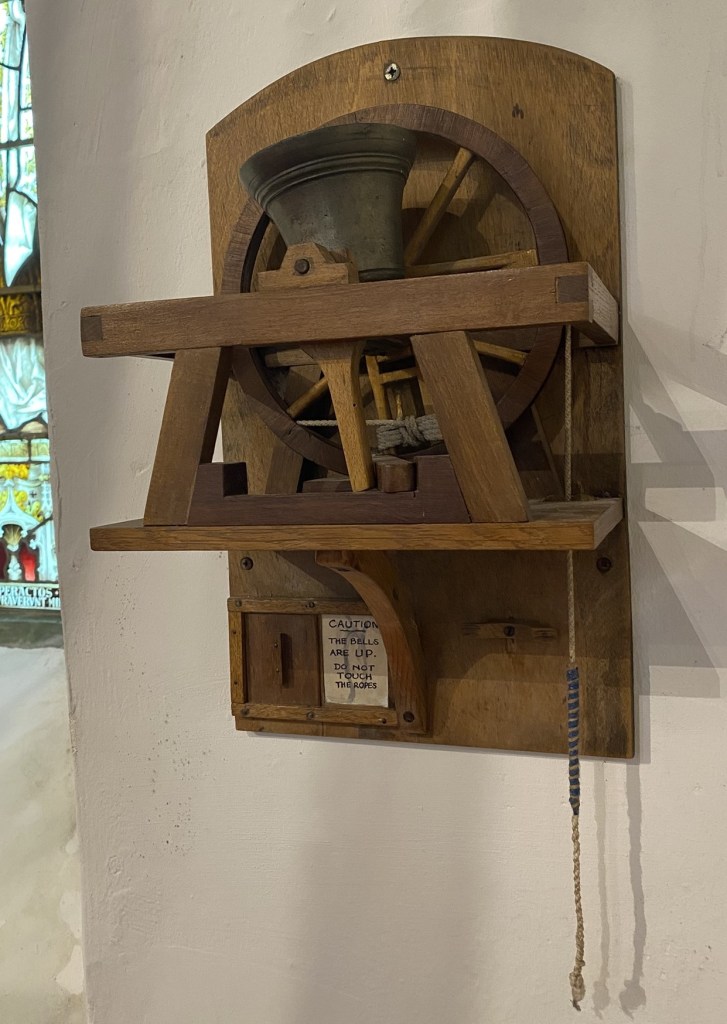
Like all the learners we have taught before them, their introductory session has included an explanation of bell ringing mechanics with the aid of a model and climbing the tower to see the bells in real life.
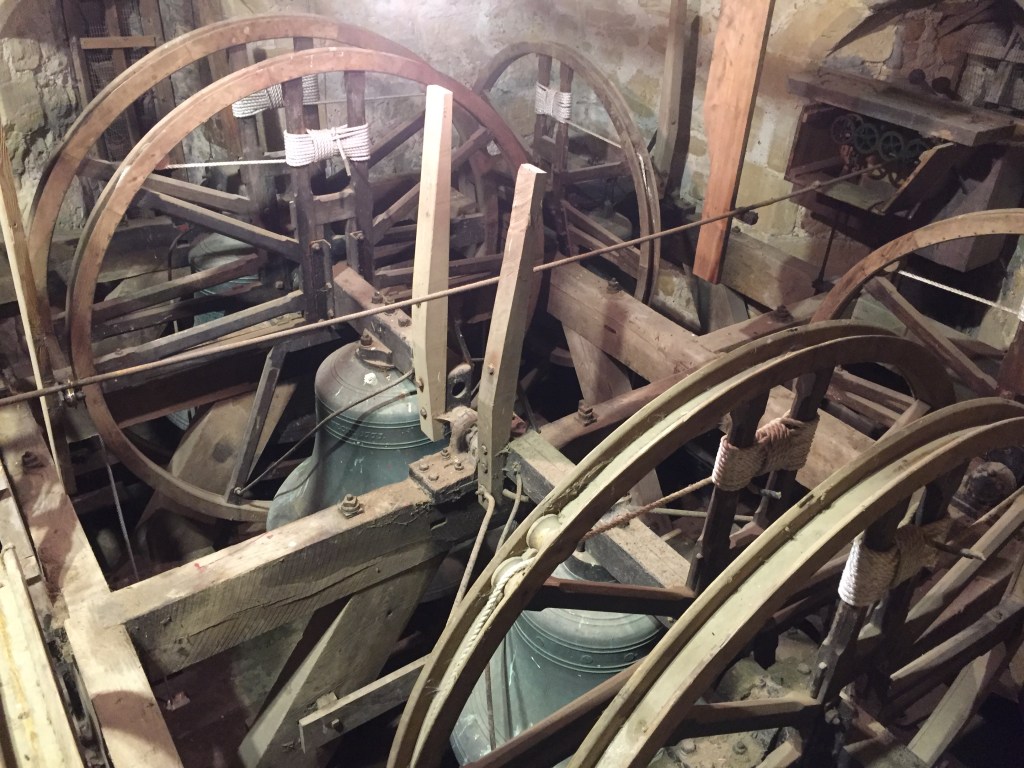
But this lesson is different. This is the first time we have been able to show the bells while they are ringing with the aid of a live video feed, visible in the ringing room.
How does the boy know that the bell is more than halfway up?
Because he can see it.
A live video feed of the bells
A few months ago, we installed a camera in the belfry to support teaching, share ringing with a wider audience and to aid in bell maintenance activities.
I’ve been reflecting on how we have used the camera since it was installed and whether it has achieved any of the things I hoped for.
From inception to completion
I first saw a live view of bells as they were being rung at a district practice at Westham, East Sussex. A laptop on a table in the corner of the ringing room showed the swing of every bell and I was transfixed. The possibilities for teaching and publicity were immediately obvious to me, and I determined to set up something similar in my home tower.
It wasn’t quite as straightforward as I naively expected. All Saints’ is a 14th-century Grade II* listed building, and, understandably, people get a bit twitchy when you say you want to drill holes in the walls.
In the end, the following things were required:
- Support from the PCC (willingly given)
- A written proposal detailing the aims and implementation details of the project
- Two revisions to my original proposal to secure the agreement of the Chichester Diocese’s architect (who was very supportive and provided valuable feedback)
- Approval from the Archdeacon for a List B change to the building
- A generous donation from a business run by one of our ringers, topped up with gift aid (thanks to PRB Consulting and the church treasurer)
- Lots of help from my wonderful electrician husband with the technical spec and installation; as an approved contractor, he also satisfied the Archdeacon’s condition for carrying out the work
- A CCTV policy (yes, really!)
- 14 months
What we achieved
The end result was a hard-wired camera, belfry lighting and a projector which can all be switched on and off from the ringing room.
We also invested in a wireless HDMI transmitter so that the image can be mirrored to another screen within the church, for viewing by the public.
See it in action!
Visualisation when teaching bell handling
It’s easy to forget how mysterious bell ringing is. When you have been ringing for a while, you can get lost in the rise and fall of the ropes, the blue line you need to learn, the rhythm of the changes.
For those new to ringing, however, everything about it is alien.
We have found that using the camera for bell handling lessons helps people in the early stages connect what they are feeling with their hands to the movement of the bell above them.
They don’t usually watch the screen while they are ringing – this would be a bit distracting – but watching while someone else is ringing gives them time to process how the rope’s movement relates to the bell, how the clapper swings and what the balance point looks like.
Last week a ringer from another tower visited and asked for help learning to stand her bell consistently, something she had been struggling with for some time. We gave her some exercises to try and talked about how it feels to stand a bell, and she was pleased with how she improved.
At the end, she commented that watching the screen while others rang helped her notice when a bell reached the balance point – or didn’t.
Some people are visual learners. For them, the camera makes all the difference.
Sharing ringing with the public
One of my biggest hopes for the installation was that it would demystify bell ringing for non-ringers, helping people to value and appreciate it.
I tested out mirroring the image to another projector in the church for our normal Sunday service ringing. After a couple of technical hitches were ironed out, it was ready for our first big screening – a visit from a local cub pack.
Our gallery ring makes All Saints’ a great place for ringing demonstrations, and a projector screen placed at the back of the church meant the cubs could watch the ringers and see the bells at the same time.
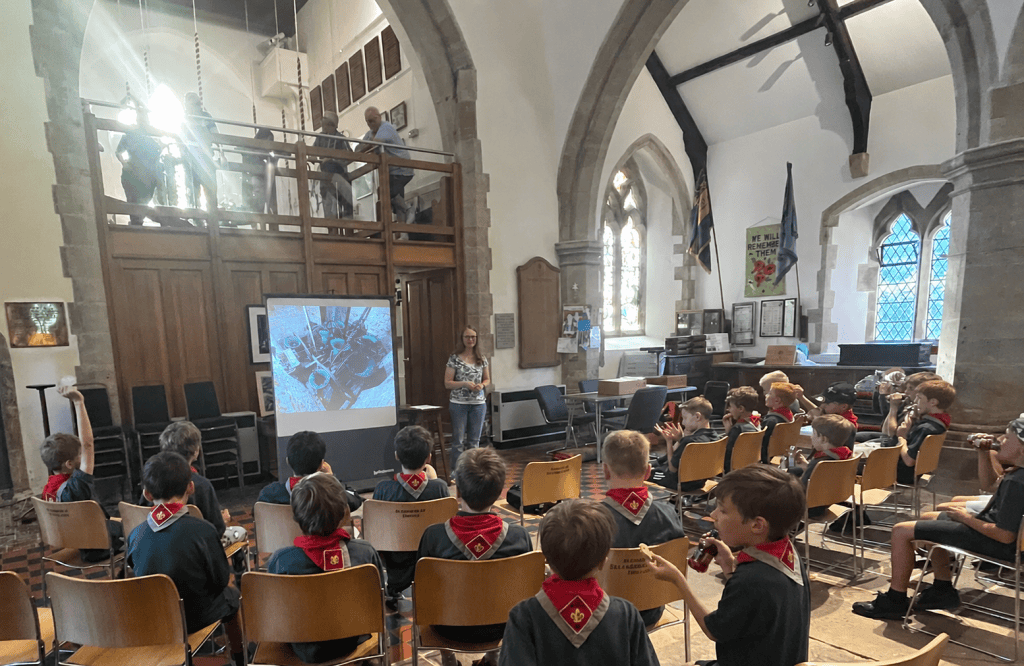
After an introduction about why we ring bells and an explanation of how they work, it was time for our first demo.
The band pulled off. On the projector screen, the bells began to move as the sound cascaded over our audience. The collective gasp of wonder was clearly audible.
“That’s wild”, I heard one of them say.
“Wild.” I am still basking in that adjective.
Even those familiar with churches can find something new to appreciate in seeing the bells from this perspective. I sent the diocesan architect a video of the finished installation to thank her for all her helpful advice. This was her response:
“This is brilliant! … It is fantastic to see the bells in action. I have been in many belfries and heard many bells, but I have never seen anything like this – isn’t it wonderful. Such an inspired idea!”
Church Architect, AABC Accredited
An aid to bell maintenance
The additional lighting we installed was an obvious improvement for anyone doing bell maintenance, but the camera brought a couple of other practical benefits.
We have a safety rule that maintenance work is always carried out by at least two people. With the camera, one person can be in the belfry while another keeps an eye on them from the ringing room. Reassuring – and useful for jobs such as adjusting the length of a rope, particularly when mobile phone signals are non-existent.
The second – and probably most interesting – use of the camera in bell maintenance has been in diagnosing issues that only occur when the bells are ringing.
We have a wooden frame and the tightening of nuts and bolts has been a regular job of our Steeple Keeper, particularly when the weather changes. The tenor has always been the most demanding bell to keep ringing smoothly, but a couple of weeks ago it still didn’t feel right, even though everything had been tightened.
By watching the screen while ringing, our Steeple Keeper realised that the tenor only misbehaved when the 7 swung a certain way, suggesting that something on the 7 was loose. She investigated, found the culprit and solved the problem. I’m sure she would have resolved it eventually without the camera, but the live view revealed a connection that was otherwise difficult to detect.
So, was it worth it?
I definitely underestimated the time and the effort required to get this project over the line. There were moments when I considered taking on HS2 next, just for some light relief.
But since we have been using the camera, I have lost count of the number of faces I have seen light up with dawning comprehension. For learners, visitors, parishioners, steeple keepers and experienced ringers, the ability to visualise the mechanics has brought a new dimension to bell ringing.
After the initial enthusiasm, the novelty of the screen wore off for our regular ringers, but they were never really the target audience. The camera is now a regular feature of bell handling lessons.
In a couple of weeks, we will be hosting a local scout group visit and there are plans for a music festival next year. The camera will play a prominent role in both events.
Personally, I find watching the bells hypnotic. Rather like gazing into the flames of a campfire, I am drawn to the movement. I keep noticing new things.
I’m not tired of watching them yet. I don’t think I ever will be.
Yes, it was worth it. And yes, I would do it all again.
If there is sufficient interest, I could write another post covering the installation process, technical specifications and costings in more detail.
Please let me know in the comments. Thank you for reading!


Leave a comment